


Editorial team · Farm Machinery
 InfoWeb Marketplace · Editorial team
Published on 9 March 2020 · 11 min read
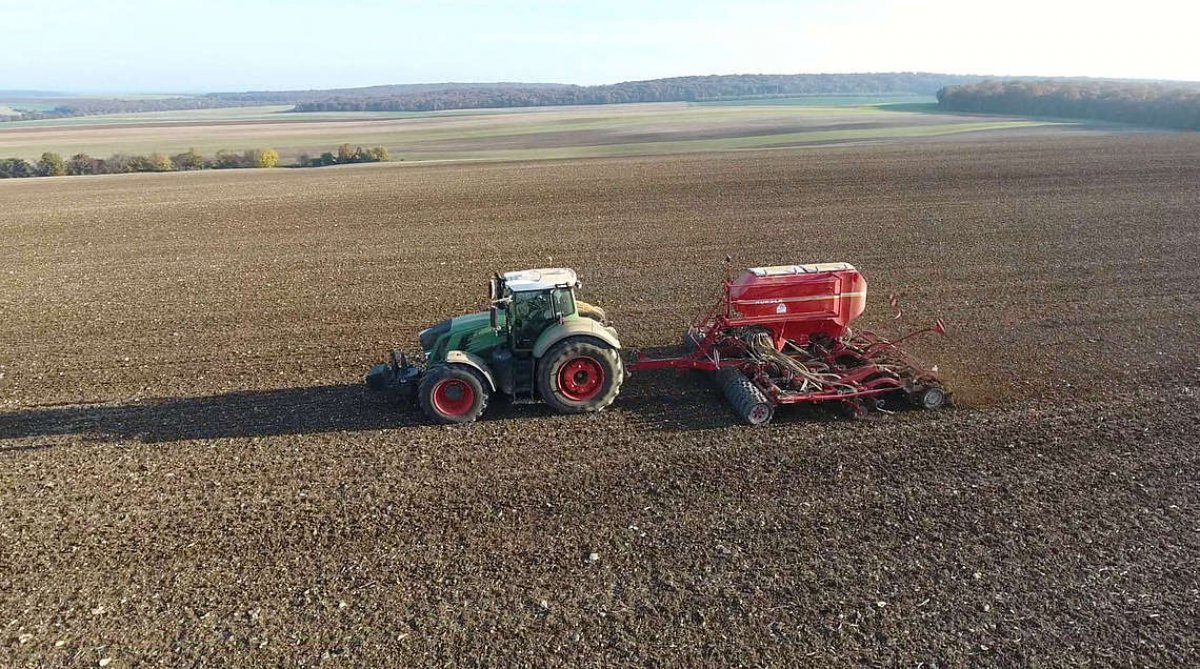
The business is built on two main farms located 50 km apart, with similar climatic conditions. Each has its own storage, in the form of silo bins and flat storage in bays. In parallel, Jean Luc Didier runs an agricultural contracting business (ETA). The soils are radically different between the two farms. 65% of the land is shallow on the Barrois plateau, with more or less stones. Soil depth varies from 10 cm to 30 cm and the stone content can rise to over 50%. 25% are drained hydromorphic clay soils and the remaining 10% are healthy clay loams. Some of the soils are sometimes made up of 60% clay, including in the stony soils. In terms of rainfall, there are sometimes differences of 200 mm between the two sites, for an average of 950 mm per year, mainly in autumn and winter.
?High clay content, hydromorphic soils, sometimes very shallow, distant plots… conditions are far from ideal, especially as some plots are also very steep – up to 100 metres of elevation change – and the recurring climatic hazards of recent years greatly affect yields and crop quality. To give you an idea, like many French farmers, in 2019 we suffered a harsh drought lasting 3 months and a particularly wet autumn: we received 392 mm within 3 months!? explained Mr. Didier.
Jean-Luc Didier set up in 1995. The farm he cultivates has been under simplified cultivation techniques, that is to say without ploughing, for 49 years (1971) because of the stones, the clay and the time required for work. He seized the opportunity to increase the size of the farm by 75% in 2005. For the economic model to be profitable, the whole machinery fleet had to be reorganised. ?There was a lot of duplication, notably a 4 m power harrow, another of 6 m, a 6 m drill and another of 8 m, making 4 drills in all. It was obvious that I had to save on equipment. So I sold 34 machines in total and bought 17, some of them second-hand.?
At the time, the farm manager was focused on an intensive model and on crops typical of the region: rapeseed, winter barley, winter wheat. Equipment purchases had to be rationalised, without over-investing and without losing sowing quality.
?I was looking for a 6 metre drill capable of sowing perfectly in heterogeneous soils, without changing settings and quickly. It had to do the work of 4 drills – in quality and versatility – and guarantee the same quality of cereal establishment in hydromorphic soils as a power harrow. It was also out of the question that I should suffer yield losses because of my drill when sowing and weather conditions were fine. Finally, the running cost ideally had to come close to that of an old Nodet drill. At the time, no drill on the market matched what I was looking for. I was not a HORSCH customer in 2005. The rotary tiller did not interest me. I found it too complicated; in my view it was an energy sink, with no work rate. Nor was I a buyer of the Deltasem CO, whose concept was not fully developed. I really liked the principle of sowing with a tine, but the Deltasem CO's tine was mounted on a double spring, with many moving parts. When the Sprinter ST came onto the market, I understood that it could meet at least one of my expectations: keeping running costs and establishment costs to an absolute minimum, notably thanks to its FlexGrip system. I also needed reassurance. When Michael Horsch explained to me that many Deltasem CO machines had been sold in England and that customers were reaching wheat yields of 100 quintals, I made up my mind. That is what tipped my choice. My machinery fleet now allows me to use only 1,9 ch per hectare, spraying included, despite the distances and steep slopes.?
The choice was not obvious for Mr. Didier. Changing his economic model and equipment was leading him into the unknown. ?I was doubtful because I had to replace a power harrow drill, which, in farming minds, is the ultimate solution when nothing else works. It does indeed allow sowing in difficult conditions. In practice, I kept the 4 m rotary one for the first year just in case.? The farmer enjoys telling the following anecdote: ?There was a year when I sowed wheat after sunflower in early November in very wet conditions, with a very narrow window without rain. To be able to sow with the dual-wheel tractor, I lifted the front of the drill so that the tractor would not spin on the slopes. I maintained my forward speed of 15 km/h. I had to sow 60 hectares in 1 day! At emergence and then at harvest, I realised that I had done work at least identical to the power harrow drill. I also realised that as long as you keep the Sprinter ST at a high speed and maintain the shattering of the soil, you do not compact the bottom of the furrow and you promote the permeability of the furrow and the plants' uptake of moisture. That is how I sold the last power harrow on the farm.?
?The Sprinter ST is an economical machine for several reasons. First of all, it is a tine drill. I estimate that its openers wear less quickly than discs. Its tines are rigid and are therefore less subject to wear. The wheels of the new models are sufficiently sized to support the frame and do not require untimely replacement. On the first model, I changed the heel of the Duett opener after only 6000 ha. And on the new models, the angle of attack of the tine had to be changed because I no longer need to change the part. I am on my third Sprinter. The first was replaced to have a double hopper and comply with road transport regulations, the second to comply with braking standards and to address the major drawback of this drill: the power requirement. On the latest model, there are two fewer tines, which is a significant asset in limiting the power requirement. Today, I average 7 l of off-road diesel per ha when sowing with the Duett opener,? explains Jean Luc Didier.
Besides the purely mechanical aspect that makes the machine economical in maintenance and fuel (when fitted with narrow points), the drill is also an asset in terms of labour and logistics. ?The machine is simple enough to set up and robust enough to be picked up quickly by a seasonal worker. You just need to position shims to set the machine's levelling and the sowing depth.? Also, compliance with road width limits saves him time between his two most distant farms and avoids the need for an escort vehicle and an extra employee. The large hopper capacity, of 5000 litres, limits the number of trips back and forth on the farm. ?It was necessary to optimise time management from this point of view, because more land had to be sown, with less equipment and fewer staff. In this respect, the larger wheel size on the latest Sprinter is appreciable.? explains the farmer.
At the time, the main constraints for using a Sprinter were simple: having firm, consolidated and level soil. But nowadays, new issues are emerging. The drill now also has to be able to pass through plant residues and cover crops.
?I have been aware for 5 years that we are in a break with the way our profession was conceived. It will require a strong capacity for adaptation because of societal pressure, restrictive environmental regulations, and insoluble technical problems such as weed infestation of soils, insect pressure, the disappearance of active substances, the lack of new products, and the questioning of glyphosate. I had been convinced for 1 or 2 years that glyphosate would be tolerated in conservation agriculture, pending the appearance of a new molecule. So it is not one element that tipped my decision about a new production method, but a combination of factors that makes me choose a new direction. In our regions, in our climates and in particularly dry soils, I think we are heading towards extensive agriculture, and that is the model I ended up choosing.?
According to Jean-Luc Didier, this involves introducing crops that he describes as ?exotic?: ?They are not fundamentally suited to our soil and climate conditions, but they are necessary in a more extensive scheme. Peas are not suited to stony soils. Oats, flax and sunflower are extremely sensitive to drought. Maize does not like stones or soils that are hydromorphic in spring or autumn. Soybean fears summer drought and can only be harvested late in the autumn. But each plant has its role to play in ?cleaning’ the plots and balancing the soils. Rapeseed can be kept, even though it is a so-called intensive crop, but it must be an integral part of a longer rotation that includes spring crop varieties. At the moment, I grow rapeseed, soybean, spring peas, oilseed flax, sunflower, winter and spring wheat, and winter and spring barley. From now on, I consider that you have to be ready to lose a little money on some crops, notably through lower yields, in order to earn it on the whole system and on the rotation.?
It is easy to see that this more extensive farming model is a logical continuation of Mr. Didier's reasoning, which is entirely directed towards a drastic reduction in costs. Since yields are capped, and since they no longer mean attractive and steady income – except in organic farming at present – the only lever for acting on the business's results is the production cost. ?With climatic shocks, it becomes difficult to hope for substantial yields. When you are in difficult years, repeatedly, you have to look at things differently. We are also at an impasse with the use of plant protection products! A limitation is going to be imposed on us. I want to clean up the fields so as not to be so dependent on herbicides. A long rotation system including split sowing (sowing decoupled from soil tillage) or direct sowing is, in my view, a solution in our low-potential clay-limestone soils.?
Jean-Luc Didier has reviewed his system to base it on the use of cover crops and their benefits as green manures. He uses protein crops, hairy vetch, Ethiopian mustard, phacelia and, in case of restructuring problems, faba bean.
?This cover is sown behind the combine harvester with the Sprinter ST, directly into the straw and notably in very stony soils. So I invested in new narrow openers with a double superimposed outlet. The small seeds are sown less deep than large-diameter seeds, such as faba bean. I sow one every 28 cm. We had exceptional sowing conditions in 2018 and 2019: excessive dryness in summer and excessive moisture in autumn. So we have not yet been able to do an economic calculation. The objective was simply to be able to sow.?
?In this configuration, the Sprinter therefore allows me to sow a green manure that rebalances my soils. My soils are indeed too rich in carbon. This increases the available water capacity but limits the effectiveness of certain root herbicides. If there is too much carbon, it is because there is not enough nitrogen. It is therefore necessary to reinject some. Green manures have this function. They also supply sugar, allow bacteria to feed and promote the mineralisation of humus and thus its uptake by spring cereals.?
Jean-Luc Didier also uses these openers for sowing rapeseed, which allows him to save on traction power. However, he changes openers to sow cereals. ?This time I use another opener with side-by-side outlets and a central outlet dedicated to fertiliser. It is the same principle as the Duett opener, but with a finer and shallower point. It requires less traction power because it lifts less wet soil. Of course, every technical choice has its share of advantages and drawbacks. Here, the major problem is fertiliser placed less deep and two seed outlets that are too close together. The objective is to get closer to direct sowing, for a surgical intervention that disturbs the soil less, in order to retain moisture and limit weed emergence.?
To conclude, Jean Luc Didier, despite some setbacks at the very beginning of the Sprinter's history and with the support of the HORSCH technical team, is satisfied with his purchase. ?I am on my third Sprinter ST.? The drill now replaces all of his sowing equipment, for sowing across all of his land, in hydromorphic soils or soils very rich in stones. It is used as much in dry conditions, with narrow points, as in wet conditions, with a front packer removed. It performs just as well in soils prepared superficially with a fertiliser opener or with fine openers so as not to disturb the soil. With fine openers, it is now able to direct-sow into short-cut stubble without pressing the straw into the bottom of the furrow and without being fuel-hungry. Jean Luc Didier finally adds: ?However, I would like the next version of the Sprinter to be suited to sowing into very well-developed green manures. During my career, I have preferred to find gradual adaptation solutions without abruptly questioning an entire system that has shown its resilience in the past. Today, faced with the abrupt changes under way and to come, I am not looking for a break with my techniques, but for constant evolution. And if possible, with the equipment already on the farms.?
Betting on the Future of Farming with the Horsch Sprinter ST Tine Drill
InfoWeb Marketplace · Editorial teamPublished on 9 March 2020 · 11 min read
We invite you to read the testimony of Mr. Jean-Luc Didier, a farmer in Haute-Marne. He takes a pragmatic view of agriculture today and, without dogmatism, applies the economic and agronomic solutions he considers right for the sound running of his farm. ?I don't want to be peremptory!? His model is based on his own experiments and cannot always be transposed, particularly to farms with high-potential land. His whole system revolves around one deep-seated motivation: a radical reduction in production costs. The Sprinter ST has become the key tool of his cropping system since 2005. ?It was not a foregone conclusion, though! I was doubtful?. Mr. Didier agreed to meet us to share his reasoning.
Advertisement
A difficult soil and climate context and geographical constraints
The business is built on two main farms located 50 km apart, with similar climatic conditions. Each has its own storage, in the form of silo bins and flat storage in bays. In parallel, Jean Luc Didier runs an agricultural contracting business (ETA). The soils are radically different between the two farms. 65% of the land is shallow on the Barrois plateau, with more or less stones. Soil depth varies from 10 cm to 30 cm and the stone content can rise to over 50%. 25% are drained hydromorphic clay soils and the remaining 10% are healthy clay loams. Some of the soils are sometimes made up of 60% clay, including in the stony soils. In terms of rainfall, there are sometimes differences of 200 mm between the two sites, for an average of 950 mm per year, mainly in autumn and winter.
?High clay content, hydromorphic soils, sometimes very shallow, distant plots… conditions are far from ideal, especially as some plots are also very steep – up to 100 metres of elevation change – and the recurring climatic hazards of recent years greatly affect yields and crop quality. To give you an idea, like many French farmers, in 2019 we suffered a harsh drought lasting 3 months and a particularly wet autumn: we received 392 mm within 3 months!? explained Mr. Didier.
A history that shapes the first equipment choices
Jean-Luc Didier set up in 1995. The farm he cultivates has been under simplified cultivation techniques, that is to say without ploughing, for 49 years (1971) because of the stones, the clay and the time required for work. He seized the opportunity to increase the size of the farm by 75% in 2005. For the economic model to be profitable, the whole machinery fleet had to be reorganised. ?There was a lot of duplication, notably a 4 m power harrow, another of 6 m, a 6 m drill and another of 8 m, making 4 drills in all. It was obvious that I had to save on equipment. So I sold 34 machines in total and bought 17, some of them second-hand.?
At the time, the farm manager was focused on an intensive model and on crops typical of the region: rapeseed, winter barley, winter wheat. Equipment purchases had to be rationalised, without over-investing and without losing sowing quality.
?I was looking for a 6 metre drill capable of sowing perfectly in heterogeneous soils, without changing settings and quickly. It had to do the work of 4 drills – in quality and versatility – and guarantee the same quality of cereal establishment in hydromorphic soils as a power harrow. It was also out of the question that I should suffer yield losses because of my drill when sowing and weather conditions were fine. Finally, the running cost ideally had to come close to that of an old Nodet drill. At the time, no drill on the market matched what I was looking for. I was not a HORSCH customer in 2005. The rotary tiller did not interest me. I found it too complicated; in my view it was an energy sink, with no work rate. Nor was I a buyer of the Deltasem CO, whose concept was not fully developed. I really liked the principle of sowing with a tine, but the Deltasem CO's tine was mounted on a double spring, with many moving parts. When the Sprinter ST came onto the market, I understood that it could meet at least one of my expectations: keeping running costs and establishment costs to an absolute minimum, notably thanks to its FlexGrip system. I also needed reassurance. When Michael Horsch explained to me that many Deltasem CO machines had been sold in England and that customers were reaching wheat yields of 100 quintals, I made up my mind. That is what tipped my choice. My machinery fleet now allows me to use only 1,9 ch per hectare, spraying included, despite the distances and steep slopes.?
Doubting the versatility of the Sprinter tine drill
The choice was not obvious for Mr. Didier. Changing his economic model and equipment was leading him into the unknown. ?I was doubtful because I had to replace a power harrow drill, which, in farming minds, is the ultimate solution when nothing else works. It does indeed allow sowing in difficult conditions. In practice, I kept the 4 m rotary one for the first year just in case.? The farmer enjoys telling the following anecdote: ?There was a year when I sowed wheat after sunflower in early November in very wet conditions, with a very narrow window without rain. To be able to sow with the dual-wheel tractor, I lifted the front of the drill so that the tractor would not spin on the slopes. I maintained my forward speed of 15 km/h. I had to sow 60 hectares in 1 day! At emergence and then at harvest, I realised that I had done work at least identical to the power harrow drill. I also realised that as long as you keep the Sprinter ST at a high speed and maintain the shattering of the soil, you do not compact the bottom of the furrow and you promote the permeability of the furrow and the plants' uptake of moisture. That is how I sold the last power harrow on the farm.?
A Horsch tine drill that proves economical
?The Sprinter ST is an economical machine for several reasons. First of all, it is a tine drill. I estimate that its openers wear less quickly than discs. Its tines are rigid and are therefore less subject to wear. The wheels of the new models are sufficiently sized to support the frame and do not require untimely replacement. On the first model, I changed the heel of the Duett opener after only 6000 ha. And on the new models, the angle of attack of the tine had to be changed because I no longer need to change the part. I am on my third Sprinter. The first was replaced to have a double hopper and comply with road transport regulations, the second to comply with braking standards and to address the major drawback of this drill: the power requirement. On the latest model, there are two fewer tines, which is a significant asset in limiting the power requirement. Today, I average 7 l of off-road diesel per ha when sowing with the Duett opener,? explains Jean Luc Didier.
Besides the purely mechanical aspect that makes the machine economical in maintenance and fuel (when fitted with narrow points), the drill is also an asset in terms of labour and logistics. ?The machine is simple enough to set up and robust enough to be picked up quickly by a seasonal worker. You just need to position shims to set the machine's levelling and the sowing depth.? Also, compliance with road width limits saves him time between his two most distant farms and avoids the need for an escort vehicle and an extra employee. The large hopper capacity, of 5000 litres, limits the number of trips back and forth on the farm. ?It was necessary to optimise time management from this point of view, because more land had to be sown, with less equipment and fewer staff. In this respect, the larger wheel size on the latest Sprinter is appreciable.? explains the farmer.
New questions about the use of drills
At the time, the main constraints for using a Sprinter were simple: having firm, consolidated and level soil. But nowadays, new issues are emerging. The drill now also has to be able to pass through plant residues and cover crops.
?I have been aware for 5 years that we are in a break with the way our profession was conceived. It will require a strong capacity for adaptation because of societal pressure, restrictive environmental regulations, and insoluble technical problems such as weed infestation of soils, insect pressure, the disappearance of active substances, the lack of new products, and the questioning of glyphosate. I had been convinced for 1 or 2 years that glyphosate would be tolerated in conservation agriculture, pending the appearance of a new molecule. So it is not one element that tipped my decision about a new production method, but a combination of factors that makes me choose a new direction. In our regions, in our climates and in particularly dry soils, I think we are heading towards extensive agriculture, and that is the model I ended up choosing.?
According to Jean-Luc Didier, this involves introducing crops that he describes as ?exotic?: ?They are not fundamentally suited to our soil and climate conditions, but they are necessary in a more extensive scheme. Peas are not suited to stony soils. Oats, flax and sunflower are extremely sensitive to drought. Maize does not like stones or soils that are hydromorphic in spring or autumn. Soybean fears summer drought and can only be harvested late in the autumn. But each plant has its role to play in ?cleaning’ the plots and balancing the soils. Rapeseed can be kept, even though it is a so-called intensive crop, but it must be an integral part of a longer rotation that includes spring crop varieties. At the moment, I grow rapeseed, soybean, spring peas, oilseed flax, sunflower, winter and spring wheat, and winter and spring barley. From now on, I consider that you have to be ready to lose a little money on some crops, notably through lower yields, in order to earn it on the whole system and on the rotation.?
It is easy to see that this more extensive farming model is a logical continuation of Mr. Didier's reasoning, which is entirely directed towards a drastic reduction in costs. Since yields are capped, and since they no longer mean attractive and steady income – except in organic farming at present – the only lever for acting on the business's results is the production cost. ?With climatic shocks, it becomes difficult to hope for substantial yields. When you are in difficult years, repeatedly, you have to look at things differently. We are also at an impasse with the use of plant protection products! A limitation is going to be imposed on us. I want to clean up the fields so as not to be so dependent on herbicides. A long rotation system including split sowing (sowing decoupled from soil tillage) or direct sowing is, in my view, a solution in our low-potential clay-limestone soils.?
Using the Sprinter ST in a more extensive system
Jean-Luc Didier has reviewed his system to base it on the use of cover crops and their benefits as green manures. He uses protein crops, hairy vetch, Ethiopian mustard, phacelia and, in case of restructuring problems, faba bean.
?This cover is sown behind the combine harvester with the Sprinter ST, directly into the straw and notably in very stony soils. So I invested in new narrow openers with a double superimposed outlet. The small seeds are sown less deep than large-diameter seeds, such as faba bean. I sow one every 28 cm. We had exceptional sowing conditions in 2018 and 2019: excessive dryness in summer and excessive moisture in autumn. So we have not yet been able to do an economic calculation. The objective was simply to be able to sow.?
?In this configuration, the Sprinter therefore allows me to sow a green manure that rebalances my soils. My soils are indeed too rich in carbon. This increases the available water capacity but limits the effectiveness of certain root herbicides. If there is too much carbon, it is because there is not enough nitrogen. It is therefore necessary to reinject some. Green manures have this function. They also supply sugar, allow bacteria to feed and promote the mineralisation of humus and thus its uptake by spring cereals.?
Jean-Luc Didier also uses these openers for sowing rapeseed, which allows him to save on traction power. However, he changes openers to sow cereals. ?This time I use another opener with side-by-side outlets and a central outlet dedicated to fertiliser. It is the same principle as the Duett opener, but with a finer and shallower point. It requires less traction power because it lifts less wet soil. Of course, every technical choice has its share of advantages and drawbacks. Here, the major problem is fertiliser placed less deep and two seed outlets that are too close together. The objective is to get closer to direct sowing, for a surgical intervention that disturbs the soil less, in order to retain moisture and limit weed emergence.?
A multi-purpose drill
To conclude, Jean Luc Didier, despite some setbacks at the very beginning of the Sprinter's history and with the support of the HORSCH technical team, is satisfied with his purchase. ?I am on my third Sprinter ST.? The drill now replaces all of his sowing equipment, for sowing across all of his land, in hydromorphic soils or soils very rich in stones. It is used as much in dry conditions, with narrow points, as in wet conditions, with a front packer removed. It performs just as well in soils prepared superficially with a fertiliser opener or with fine openers so as not to disturb the soil. With fine openers, it is now able to direct-sow into short-cut stubble without pressing the straw into the bottom of the furrow and without being fuel-hungry. Jean Luc Didier finally adds: ?However, I would like the next version of the Sprinter to be suited to sowing into very well-developed green manures. During my career, I have preferred to find gradual adaptation solutions without abruptly questioning an entire system that has shown its resilience in the past. Today, faced with the abrupt changes under way and to come, I am not looking for a break with my techniques, but for constant evolution. And if possible, with the equipment already on the farms.?