


Case IH defines automation categories and announces a pilot program
 InfoWeb Marketplace · Editorial team
Published on 16 July 2018 · 3 min read
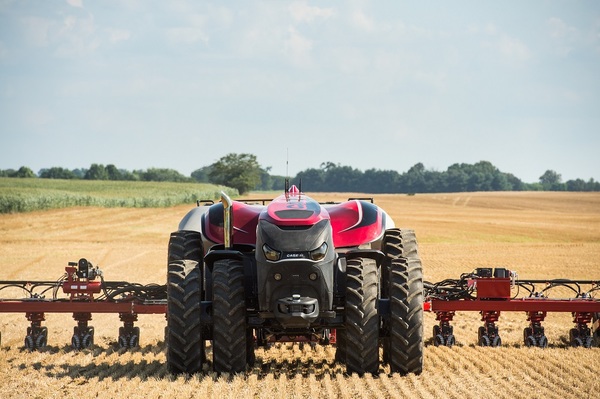
Agricultural automation can be divided into five categories. First field trial with Bolthouse Farms, a division of the Campbell Soup Company.
Since announcing the autonomous vehicle concept, Case IH has advanced the technology and brought a new definition of automation to agriculture.
The brand has spoken with customers around the world to study how this technology could be implemented so that they gain the greatest benefits in their work. Today, through its autonomous vehicle program, Case IH is researching and piloting automation technologies in real-life scenarios.
?While the autonomous concept vehicle revealed in 2016 showed the world what is possible with autonomous vehicles, it was still a concept. That tractor at work therefore served as a basis for starting discussions with farmers and the industry about the technology needed for the high-yield farms of today and tomorrow,? said Robert Zemenchik, Case IH AFS systems marketing manager. ?We are ready to show how the agricultural application of automation can advance the precision farming solutions that our customers are currently using on their farms.?
Five automation categories for agriculture
The diversity of farming operations around the world requires different levels of automation. As part of its research for customer-oriented product design, Case IH has defined five categories of farm operation automation to meet current and future technology needs. The types of activities associated with each level include:
- Auto-guidance
- Coordination and optimization
- Automation assisted by one or more operators
- Supervised automation
- Full automation
?It is interesting to see the savings that automation and, eventually, full autonomy can bring to each farm,? said Zemenchik. ?The logic behind defining automation categories is to show what is possible in each of them. They are not linear, and a given fleet can even fall into several categories at the same time. Today, many of our customers already use auto-guidance and/or operator-assisted automation.?
The five categories defined by Case IH start with the automation of specific tasks on a piece of equipment. Case IH was the first manufacturer to offer growers automation technology in the 1990 with the AFS AccuGuide™ auto-guidance system, and it continues today with more advanced solutions, such as the AFS AccuTurn™ system, which automates headland turns, and AFS Soil Command™ technology for seedbed sensing.
Researching and piloting autonomous technologies in the field
In 2018, Case IH is working with Bolthouse Farms on an autonomous tractor pilot program. The aim of this program is to understand how new autonomous technologies can be used and how they meet the real needs of farms.
?The only way to validate on-farm uses of autonomous technology is to test it in the field, by having farmers use it on their farm, integrate it into their fleet and carry out their daily operations.? explained Zemenchik.
As one of the largest carrot producers in North America, Bolthouse Farms operates a vast area of farmland year-round in four US states and in Canada. The pilot project of the Case IH automation program is part of the company's efforts to develop cutting-edge technologies and improve productivity.
The project will first focus on plowing and deep tillage (two highly repetitive tasks that Bolthouse Farms performs year-round) with a small fleet of autonomous Steiger® and Quadtrac® tractors pulling a True-Tandem™ disc harrow or an Ecolo-Tiger® disc ripper. These trials will assess the control of autonomous machines across a variety of tillage applications, soil types, weather conditions, and sensing and perception activities.
?One of the main objectives is to gather feedback from agronomists and operators on the use of autonomous technology in real farming conditions, so that Case IH can develop and refine its technology control and machine optimization systems? said Zemenchik. ?In addition, Bolthouse Farms may suggest some applications of automation that we may not have thought of yet.?
Brian Grant, vice president of Bolthouse Farms, sees the autonomous tractor pilot program as an opportunity to find new solutions to increase the company's efficiency and provide high-quality food to meet the needs of a growing population.
?We are just beginning to explore the concept of an autonomous tractor and to ask ourselves, as Case IH engineers do, what autonomous tractors are capable of doing? said Grant. ?And the answers to those questions are not ?if’ but ?when’.?
Case IH will provide periodic updates throughout the pilot program.
For more information: