


Case IH launches a third tractor in its Optum range
 InfoWeb Marketplace · Editorial team
Published on 9 March 2018 · 2 min read
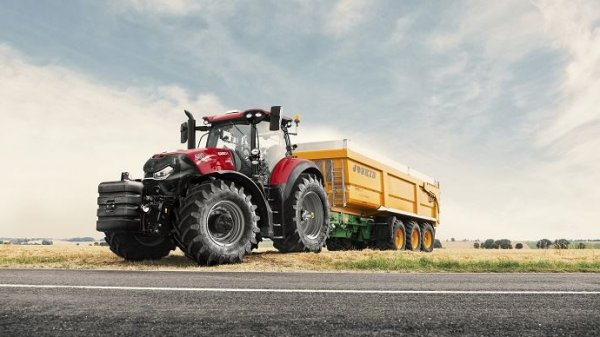
The Optum 250 CVX joins the OPTUM range. With a rated power of 250 horsepower, it completes the range, which already includes models of 270 and 300 ch.
Equipped with a CVX Drive continuously variable transmission and reaching a maximum power of 273 ch, the OPTUM 250 is also positioned as a complement to the PUMA 240 CVX.
Also built at the St Valentin plant in Austria, it is offered with a series of options designed to deliver a tractor that is competitive in terms of features and performance while also being an attractive entry-level model.
With a gross vehicle weight of 16 800 kg, the Optum 250 is a larger alternative to the Puma 240 CVX.
It was introduced to meet the growing demand for tractors that combine a power output of 250-300 ch, a high payload and compact dimensions.
The Optum 250 also benefits from the same 2 995mm wheelbase as the other models in the range.
The Optum tractors are designed to be used without ballast for jobs requiring high power and low weight (mowing) or with ballast for jobs requiring a high level of traction performance (tillage).
The Optum 250 CVX is equipped with an extremely robust class 4.75 front axle and a 6,7-litre six-cylinder FPT Hi-eSCR Stage IV engine, with turbocharger and intercooler, like the proven system already used in the existing Optum models.
To promote fuel economy, the engine speed is reduced from 850 tr/min to 650 tr/min after the tractor has been stationary for two minutes. The fuel tank, with a capacity of 410 litres, is more than sufficient.
Options include advanced anti-lock braking (ABS) and an engine braking system.
The latter works in combination with a variable-pitch fan, a solution unique in the tractor industry that meets the demands of high braking efficiency, providing up to 149 kW of braking power to ensure fast and safe braking, or even a complete stop, of the tractor.
The Optum 250 CVX is equipped with a category 3N rear hitch capable of lifting up to 11 058 kg over the full stroke. All hydraulic requirements are handled by a flow- and pressure-compensating pump.