


CLAAS agricultural equipment wins medals at the SIMA INNOVATION AWARDS
 InfoWeb Marketplace · Editorial team
Published on 7 December 2018 · 3 min read
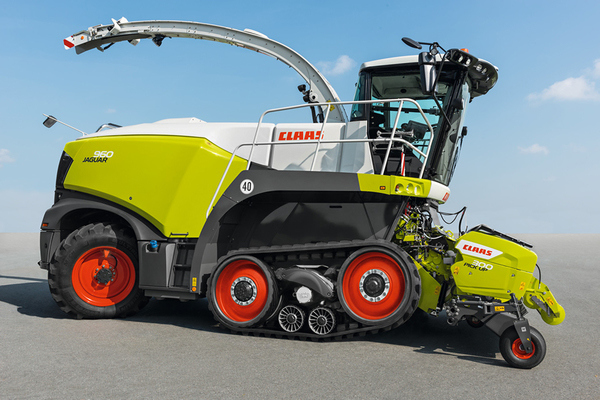
At the SIMA Preview, CLAAS stood out as the only company to receive 3 medals for its innovations, which will be exhibited at SIMA in February 2019.
A gold medal for the JAGUAR 960 TERRA TRAC forage harvester with suspended tracks.
CLAAS, known for its range of TERRA TRAC half-track combine harvesters, has just overcome the main obstacle that limited the use of tracks on self-propelled forage harvesters: skidding during maneuvers.
An automatic lifting system for the front roller on headlands considerably limits skidding when working on a standing crop (grass, alfalfa). This intelligent system is triggered beyond a certain turning radius and does not damage the soil structure.
Indeed, the average pressure of the remaining contact surface (approximately 60 %) is more favorable than that of standard tires.
This device, combined with the rear central tire inflation system, is a real advantage for soil protection. This technological breakthrough in tracked vehicles was achieved simply by controlling the existing hydraulic systems on the suspended track unit.
Depending on the steering angle, the hydraulic pressure on the track support rollers increases automatically. Only the support rollers and the rear drive wheels still touch the ground, which reduces the ground contact surface by about one third.
The JAGUAR 960 TT is lengthened by more than one meter by its tracked equipment, and this larger size provides a real advantage in terms of maintenance, particularly regarding access to the kernel processor and the accelerator.
As the obstacle to fitting forage harvesters with tracked units is thus removed, the solution also provides a satisfactory answer to the regulatory issue of maximum axle loads.
The 13-tonne limit on roads, recently raised to 14 tonnes under pressure from manufacturers, is easily exceeded by harvesting machinery as soon as they carry their foldable front attachments. Road travel benefits from a speed of 40 km/h (where legislation permits) and an overall width of 3 m.
A bronze medal for the TORION SINUS wheel loader.
The ?SINUS? design combines the two steering modes commonly used on wheel loaders, namely:
- Central articulation, which has the advantage of operating with the tool always in line with the front axle, but whose main drawback is stability when fully steered.
- The 4 steered wheels, with the drawbacks of not operating with the tool (bucket, fork, etc.) always in line with the front axle, and of having a large turning radius of the front tool.
The choice of an articulation limited to 30° and a rear steering axle eliminates the drawbacks of both systems while preserving their respective advantages. By avoiding a reduction in overhang, the risk of accidents is kept under control.
Maneuverability is compensated by the rear steering axle. The steering synchronization system is mechanical, using rods and steering levers controlled by the articulation. Simple and reliable, it addresses agricultural safety concerns by avoiding errors in the choice of steering mode.
The system offered by CLAAS exists on the loaders of its partner Liebherr, but the technical collaboration conducted in parallel with the 2015 commercial agreements made it possible to meet the agricultural specifications desired by CLAAS, in particular the oscillation damping system on the SINUS central articulation.
A bronze medal for the CONVIO FLEX flexible draper header.
The commonly encountered arable crop rotation of wheat-barley-rapeseed is tending, for various reasons, to evolve toward more complex farming systems combining many crops.
The trend toward short supply chains and local designations (e.g. Berry lentils), the development of organic farming and of soybean acreage are changing cropping practices to meet consumer expectations. Some farmers now harvest up to 18 different crops in a season. This development required the creation of a new, highly versatile cutterbar capable of picking up without losses the lowest and most varied crops: rapeseed, soybeans, cereals, faba beans, sunflowers, peas, lentils, etc.
The new CONVIO FLEX header combines all the desirable criteria, taking up the well-known principles of the draper header and of flexibility, already present in North America, in a new, highly sophisticated whole.
For the first time, the belt speed is proportional to the forward speed, and the AUTOCONTOUR FLEX controls the adjustment of the conveyor in addition to its own flexibility travel of 225 mm. Communication between the header and the machine makes it possible to adjust all the main settings from the CEBIS in the cab.