


Claas Maxflo, Vario, Maxflex, Conspeed and Sunspeed headers for harvesting cereals, rapeseed, maize, soybeans and sunflowers
 InfoWeb Marketplace · Editorial team
Published on 14 August 2010 · 3 min read
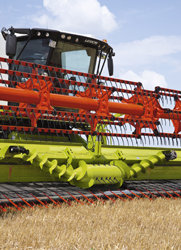
Harvesting starts with the header. Claas therefore aims to offer cutterbars suited to the different types of crop, whether wheat, rye, barley, oats and triticale, or rapeseed, maize, sunflower, rice, soybeans, flax, beans, lentils, grass or clover seed, or millet.
The multi-coupler and the central locking system would allow front attachments to be fitted to all Claas combine harvesters.
With the Maxflo header, Claas adopts side belts instead of the feed auger
According to the German manufacturer, the new Maxflo cutterbar is suited to areas with average yield levels. Unlike cutterbars with a feed auger, the Claas Maxflo uses conveyor belts (one on the right and one on the left) that bring the crop back to the center of the header.
Augers located on the sides of the feed auger then pick up the crop. This principle would ensure reliable conveying, even for small quantities. The speed of the belts in the cutterbar can be adjusted from the cab via the on-board computer, the Cebis.
Note that the Maxflo can also be used for swathing (for example, rapeseed).
The Vario 1200 and the new Vario 1050 for a uniform crop flow in cereals and rapeseed
The Vario cutterbar is now available in cutting widths from 5,40 meters to 12 meters. According to Claas, by extending the cutting table by 20 cm, or even 50 cm for rapeseed (or shortening it by 10 cm), the Vario header ensures a steady feed of the harvested crop into the threshing system, thus improving the combine's potential. The Vario would also help reduce fuel consumption.
Note that the kinematics of the Claas Vario V1050 header have been modified and it now features a dual synchronous drive (drive from the left and from the right).
The diameter of the feed auger has also been increased, to 660 mm, thus offering better protection against wrapping and better crop conveying.
The new tine arms and reel bearings, as well as the new reel shape, would reduce the risk of the harvested crop wrapping.
The Maxflex header: the Claas solution for soybeans
Legumes such as soybeans grow in pods located very close to the ground. To ensure a harvest without major losses, it is therefore necessary to cut very close to the ground so as not to leave any pods behind.
Claas has fitted the Maxflex cutterbar with a 18 cm flexible cutting table that would automatically adapt to the slightest unevenness of the ground.
The feed auger, the reel and the cutting table are split. The cutting angle of the feeder housing can be adjusted. The Maxflex cutterbar would also be suited to dry peas, clover, etc.
The Claas Conspeed and Conspeed Linear corn headers for harvesting maize
The Claas Conspeed is equipped with conical picking rollers. They first pull the plants down slowly, so that the ears are positioned on the plates. The rest of the plant is then pulled down quickly.
This design would ensure a high picking capacity, gentle handling of the ears and reduced losses from ejection.
The Claas Conspeed Linear, on the other hand, is equipped with linear picking rollers with a gear drive. The six different picking speeds are achieved by simply replacing two pinions.
The straight and linear picking rollers have front bearings, which would make them particularly robust.
Note that the Claas Conspeed Linear corn header can also be used to harvest sunflowers after conversion. To do this, the knives must be fixed above the picking rollers. Hood extensions and a rear fairing must be fitted. The chain is turned and the guidance modified.
The Claas Sunspeed on tour in sunflowers
The Sunspeed cutterbar would offer optimal work output and a minimal level of losses when harvesting sunflowers. The fact that only the sunflower heads enter the machine ensures high grain cleanliness and low wear.
With the Sunspeed header, when the sunflowers are gripped, the adjustable guide plate helps push the sunflower heads forward. The gap between the picking elements can be adapted to the thickness of the stalks thanks to the adjustment rails.
As a result, no blockages form and harvesting is carried out at a high working speed. The pulling cylinder prevents cutting too early.
Thus, only the sunflower heads end up in the special reel fitted with tines and additional rubber guides. The reel conveys the heads to the feed auger, from where they are fed into the feeder housing.