


Claas Scorpion telescopic handlers for agricultural use: more power and more comfort
 InfoWeb Marketplace · Editorial team
Published on 5 July 2013 · 6 min read
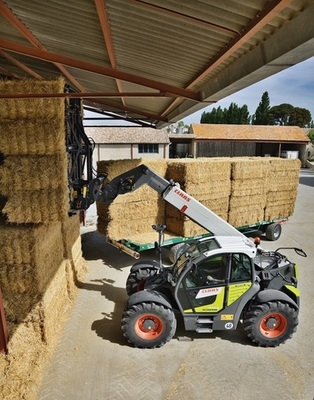
Following the launch of the Scorpion telescopic handler in 2005, Claas is completely redesigning this series in 2013, offering more power and more comfort.
The six new Claas Scorpion models offer lift heights from 6 to 8,80 m and lift capacities from 3 to 5,50 tonnes. The three large Scorpion models 7044, 7055 and 9055 will be available in October 2013.
For the more compact Scorpion 6030, 7030 and 7035, customers will have to wait until February 2014.
Telescopic handlers for agricultural use
Claas has been building telescopic handlers for agricultural use for 20 years and has thus acquired know-how from which the Scorpion telescopic handlers, built in Pfullendorf by its partner Kramer, benefit.
Between 2006 and today, the number of units sold has increased at least sevenfold.
Since May 2008, all Claas telescopic handlers intended for the global market have been built in the brand-new Pfullendorf plant.
Increased power and comfort
In many countries, farmers want telescopic handlers with a lift capacity above 5 t in the upper power range, and improved driving dynamics and comfort in the medium and lower power ranges.
The three new large-frame Scorpion 7044, 7055 and 9055 and the three new, more compact Scorpion 6030, 7030 and 7035 aim to meet this requirement.
The previous maximum lift capacity of 4,4 t is now 5,5 t on the two new top-of-the-range models 7055 and 9055, with a maximum lift height of 7 m or 8,8 m. In addition, these telescopic handlers deliver higher breakout force and hydraulic power.
New chassis with very low center of gravity
The chassis has been redesigned on both ranges to be able to support higher loads. The low position of the telescopic boom in the chassis is another feature.
When the telescopic boom is lowered, it rests entirely on the chassis, which provides better stability as well as a clear view to the right side of the machine. Thanks to the new chassis, the maximum possible tire size is now 600/55R26.5.
New loader system
The loader system has also been completely redesigned. Its new structure and kinematics enable the new Scorpion models to offer a breakout force of 72 kN and a residual load capacity of 2 t.
The tilt cylinder and the telescopic boom are fitted with end-of-stroke damping, which protects the loader system from shocks.
In addition, the telescopic boom is equipped with boom suspension via an automatic load stabilizer. In automatic mode, the boom suspension activates automatically at a speed of 7 km/h or above and deactivates below this threshold.
Loader system controls
On the six new models, the right-hand console of the dashboard and the joystick have been completely redesigned, as has the rotary selector on the dashboard for selecting the three steering modes (front-axle steering, four-wheel steering and crab steering).
Located within easy reach and in the driver's field of vision, it allows the steering mode to be changed by simply pressing and turning.
The new large-frame models achieve a turning radius of only 3 755 mm compared with 3 750 mm for the small-frame models.
Installed on the right armrest of the driver's seat on the three large models and on the right-hand console for the more compact range, the joystick offers maximum comfort for controlling 13 functions.
New compared with previous models, it also allows the selection of the three ranges: ?snail? from 0 to 7 km/h, ?tortoise? from 0 to 15 km/h and ?hare? from 0 to 30/40 km/h. If the driver limits the maximum speed, they can slightly increase the engine speed to use the full hydraulic power.
The choice of range also affects the sensitivity of the accelerator pedal. On the new telescopic handlers, the three ranges can be selected while moving and under full load by simply pressing the dedicated button.
All models are available in 20 km/h, 30 km/h and 40 km/h versions.
?Smart Handling?
Claas's ?Smart Handling? system contributes to safety at work with telescopic handlers by offering several automatic functions and operating modes with integrated overload protection.
Four working modes are available: the ?buckets? mode, the ?pallets? mode, the vertical lift system and the manual mode.
Thanks to Smart Handling, the lowering speed is adapted according to the load and the tilt angle of the loader system in each of the modes. The higher and heavier the load being carried, the lower the maximum lowering speed.
Overload protection is deactivated when the boom is fully retracted to allow bucket loading or pushing work at full power.
In certain cases, the overload protection can be deactivated by the driver using a two-handed control for a maximum of 60 seconds.
Automatic bucket return is a new automatic function that makes work even easier. At the press of a button, the implement is brought to a given position, which can easily be stored during work. The front implement can be steered continuously with great precision for fast loading cycles.
Working hydraulics with new pressure release control
The new telescopic handlers feature load-sensing working hydraulics delivering an increased hydraulic flow rate.
This is now 187 l/min on the Scorpion 7055 and 9055 models, and 140 l/min on the Scorpion 7044.
The three more compact models are available with a choice of a gear pump delivering 100 l/min or load-sensing working hydraulics offering a flow rate of 140 l/min.
The new external pressure release control in the 3e circuit on the gooseneck of the telescopic boom allows pressure to be released from the hydraulic couplings of the implement carrier while the engine is running, so that implements can be changed more easily and quickly.
New drive system
The system incorporates new-generation Deutz engines, compliant with the Stage IIIb emissions standard (Tier 4i), which are reported to stand out for higher torque and low fuel consumption.
The two largest models 7055 and 9055 are equipped with 4-cylinder engines with a displacement of 4,1 l developing 156 ch, compared with 4-cylinder engines of 3,6 l and 122 ch for the Scorpion 7044 and the more compact models (Scorpion 6030, 7030 and 7035) (at a speed of 2 300 tr/min according to ECE R120).
For emission control on the 4,1 l engines, Claas combines a self-cleaning diesel particulate filter (DPF) with a maintenance-free diesel oxidation catalyst (DOC). On the 3,6 l engine of the Scorpion 7044, exhaust gas aftertreatment uses only a maintenance-free DOC catalytic system.
The cooling air is drawn in at the upper part of the engine hood. It passes through the radiator and is routed along the engine block before leaving the engine compartment at the top rear of the hood, together with the exhaust gases.
This air circuit notably helps prevent dust and dirt from being swirled up or drawn in.
Clean air is also drawn in from above for the fan reversal at the rear of the machine.
Transmission with maximum pushing force and ?Smart Roading? function
The key component of the CPS system of the new telescopic handlers is the intelligent ?Varipower? hydrostatic transmission, which automatically and continuously adapts speed and pushing force, allowing the Scorpion to continuously reach a maximum speed of 40 km/h.
For increased driving dynamics and pushing force, the two new top-of-the-range models can be fitted with the more powerful ?Varipower Plus? transmission and the ?Smart Roading? function: when the maximum speed is reached in four-wheel steering mode (30 km/h) and front-axle steering mode (40 km/h), the engine speed can be lowered to 1 800 tr/min for the Scorpion 7044, 7055 and 9055, and to 2 000 tr/min for the Scorpion 7044.
Fuel consumption would thus be significantly reduced during transport and handling work on the farm.
In addition, the reduced engine speed lowers the noise level while working with the loader. According to the German manufacturer, the ?Smart Roading? function adjusts automatically.
The driver determines the travel speed with the accelerator pedal. The engine speed is automatically reduced as soon as the maximum speed is reached.
For maximum traction when pushing in difficult conditions, the 100 % differential lock on the front axle can be activated by pressing a button on the joystick.
More spacious, comfortable and ergonomic cab
The cab of the new Scorpion is larger (+5 % space and +9 % interior width), with 360° panoramic visibility thanks to the one-piece windshield (8,5 % more glazed surface) and many other comfort features.
In addition to the new controls described above, comfort in the cab is provided, for example, by the additional 23 l cooled compartment and by the optional dynamic suspension seat. The main operating states are displayed on the right-hand pillar on the new models.
Two large storage spaces are integrated into the low ballast at the rear of the machine. They offer a storage volume of 44 l and their covers can be locked.
Night work is possible thanks to the backlighting of the dashboard elements and the 9 work lights, also available in an optional LED version. The FOPS protective grille is now located inside the cab.