


Claas: the market's widest range of forage harvesters with the Jaguar 800 and 900
 InfoWeb Marketplace · Editorial team
Published on 31 October 2013 · 4 min read
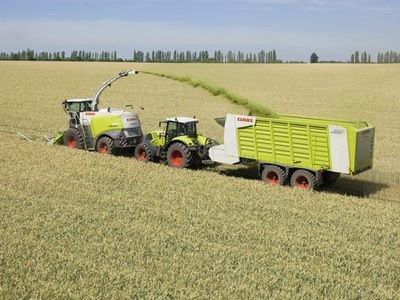
Claas continues its dual-offer strategy with the new Jaguar 800 and 900 and, with 11 models, presents the widest range of forage harvesters worldwide.
With innovations in control system (CEBIS, Cruise Pilot, Comfort Cut...), maintenance (engine cooling, bonnet opening, sharpening..) and maneuverability (smaller turning radius for the Jaguar 900).
The new Jaguar 800 and 900 will be available from January 2014.
A design with curved lines on the Claas Jaguar 800 (830 - 870)
With its curved lines, the new Jaguar 800 series recalls the design of the 900 series. Its new shapes give the driver a clear view to the side and rear.
It features an air circulation system for better engine and hydraulic cooling. The "Vista Cab" comfort cab and the Cebis control concept of the new Jaguar 800 offer more visibility and more comfort.
All the "Easy" functions and the driver assistance systems of the Jaguar 900 now also equip the Jaguar 800.
Another new feature: the Claas Jaguar 800 can now be optionally equipped with the "Multi Crop Cracker" (crop processor) and a mechanical adjustment of the accelerator position, which optimizes the material flow.
In addition, they benefit from the "Quick Coupleur" mechanical quick coupling and a "push pull" hydraulic connection, allowing easy adaptation of front attachments. Thus, both series have a similar interface for front attachments.
The "Dynamic Power" system, which adapts engine power and fuel consumption to different uses, will now also be available on the Jaguar 860 and 870.
"Dynamic Cooling", "Comfort Cut", inclined rear axle on the Claas Jaguar 900 (930 - 980)
The Jaguar 900 series now features "Dynamic Cooling", that is, automatic adjustment of the fan speed according to the temperature of the radiator water, hydraulic oil and charge air, thanks to a variable-speed drive.
When the cooling requirement is low, savings of nearly 16 ch can be achieved. This energy can be used directly to increase cutting performance.
Claas presents another "exclusive" innovation on the "Jaguar 980" series with automatic adjustment of the forward speed. Called "Cruise pilot", it was previously only available on "Lexion" combine harvesters.
Cruise Pilot ensures that the rotor is always fed evenly with optimal engine load regardless of the quantity of forage. The desired engine speed can be preset on the CEBIS.
The driver can choose between three strategies: speed control (constant speed), power (continuous throughput) and maximum engine load.
Consistent pre-compression and continuously variable cutting length adjustment
Another innovation of the Claas Jaguar 900 forage harvester series concerns the pre-compression rollers: a traction cylinder holds the upper rear roller with constant pressure on the crop and thus guarantees pre-compression independent of the height of the forage mat.
Thus, even with a light crop, pre-compression is optimal, as is cutting quality.
Moreover, thanks to the new version of "Comfort Cut", the automatic cutting length adjustment is now continuous over the entire working range. This means more power in the feed rollers and total flexibility when choosing the cutting length.
Finally, the inclined rear axle of the chassis of the new Claas Jaguar 900 allows more efficient steering of up to 47° and a smaller turning radius of 12,5 m maximum.
In addition, the 900 series can now be fitted with taller tires of up to 2,05 m in diameter on the front axle and 1,65 m on the rear axle.
Innovations in the "CEBIS" control concept for the Jaguar 800 and Jaguar 900 series
The throughput-based sharpening device improves cutting quality. The driver can be alerted when the next knife sharpening and shear bar adjustment is needed based on working time (and, if a "Quantimeter" is used, based on throughput).
In addition, the CEBIS offers additional adjustment parameters. For example, when fitting used blades, it is possible to enter the wear condition of the knives in the CEBIS.
Here are the other improvements to the CEBIS control concept: in headland/field opening mode, the driver can deactivate some of the automatic functions via the presets to control the machine manually.
In the open field, all automatic functions can be reactivated simply by pressing a button. The CEBIS also has a day/night mode and displays the rear camera images when reversing.
A larger tank for the Claas Jaguar 800 and 900 forage harvesters
A larger fuel tank and an innovative maintenance concept for both series
Claas offers several Mercedes Benz engines for all Jaguar models, all compliant with the greenhouse gas treatment directives in force in the various countries (Stage IIIA (Tier 3) to Stage IV (Tier 4) via Stage IIIB (Tier 4i)).
To meet the requirements of the Stage IV (Tier 4) emissions standard, Claas uses Mercedes Benz 6-cylinder inline engines (OM 470, 471 and 473). Exhaust gas treatment is carried out by an SCR catalyst on all engines. The Jaguar 970 and 980 use MAN V8 and V12 engines.
Note that, although the new engines are more economical, Claas equips the new Jaguar with larger-capacity fuel tanks (up to 1 500 l) to reduce refueling stops.
A wider bonnet opening on the Claas Jaguar 800 and 900
The Jaguar 800 and 900 series are also equipped with the new time-saving maintenance concept. To install and remove the "Corn Cracker", the right-hand side panel can swing back by 90°.
This makes it easier to install or refit components with the help of a telehandler, for example. Likewise, the accelerator can now be removed from the side of the machine.
Innovations for the Orbis and Direct Disc front attachments
The "Orbis" corn header has a 3-speed input gearbox to adapt to different harvesting conditions.
The "Direct Disc" direct cut header can now be started in two stages thanks to its own clutch. This minimizes the starting torque and allows starting under full load.
Finally, Claas has taken into account the growing importance of preservatives, especially for grasses. For this purpose, the new Jaguar series have a large 375 l tank and a metering rate of up to 400 l/h and 2 l/t.