


CLAYDON strip till drill at SIMA
 InfoWeb Marketplace · Editorial team
Published on 2 February 2013 · 3 min read
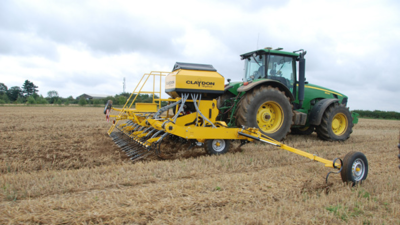
This is the first SIMA exhibition for CLAYDON, the English leader in strip drill manufacturing.
Claydon direct drills were developed 11 years ago by an ingenious farmer, Jeff Claydon. Jeff created this drill to reduce establishment costs and working time while maintaining yields on his heavy clay soils in the east of England.
Claydon drills are attracting the interest of many farmers and are revolutionizing current establishment techniques, not only in England, where the majority of sales are made, but also in France, the Netherlands and Germany.
Drills are also in operation in Scandinavia, Chile and New Zealand.
During Innov-Agri 2012 in Outarville, the Claydon drills held visitors' attention, and Benjamin Vion, the agent for France, carried out demonstrations at various sites in France.
The advantage of the Claydon Strip Drill system is that it works only the soil around the seed line. The seed is injected into fresh, clean soil.
The untilled soil between the rows maintains the natural soil structure, which helps retain soil moisture and gives rapid seed germination and no interruption to root development, producing strong plants.
In extreme moisture conditions at sowing, such as this autumn in Europe, the uncultivated strip left between each row by the Claydon drill improves bearing capacity and extends the sowing window when other drills can no longer work.
The fact that the Hybrid drill is mounted and has neither discs nor packer wheels gives substantial clearance and eliminates the risk of blockages caused by sticky soil in wet conditions.
On the Claydon farm, with its heavy clay soils, all 485 ha are established with a 6 m Hybrid at the end of September in only 150 hours. A further 1500 ha are established on a contract basis in 500 hours.
Claydon Hybrid drills are available in 3,0, 4,0, 4,8 and 6 metres. All models are fitted with Claydon's unique patented double-tine system. It is the key to creating the right environment for the seed.
This system eliminates any compaction beneath the seedbed and improves drainage. It creates a loose structure that is ideal for root development.
Direct drills with discs create compaction on the seed line.
The result is poor drainage in wet conditions and a risk of seed loss. Root development is slowed and the plants are therefore less resistant to external stresses.
To obtain the best results, the first element of the double-tine system is the carbide-protected subsoiling tine, which can work to a depth of up to 18 cm.
The seeding tine, which follows in its line, places the seed on the fissured soil using a 18 cm wide sweep point that creates fine soil and clears away all debris.
The seed is distributed in a band 15 cm wide. Lastly, a covering harrow can be fitted to the drill.
It has numerous mounting options to adapt to different conditions.
As standard, the drill is fitted with 18 cm wide seeding points. These can handle most sowing. Narrower points of 12 and 7,5 cm with their injector are also available. They can be used in very wet conditions or for special sowing.
There is also a special point for deep sowing (more than 7 cm). All points are held by Bourgault's Speed Lock quick-change system to make replacement easier.
The drill has one tine every 30 cm and leaves a 12 cm strip untilled between each row. This helps retain soil moisture and preserve the natural structure so that nutrients are more available.
In the crop, this promotes air circulation and light reaching each plant. Machinery traffic is also made easier by greater bearing capacity, which also limits compaction.
In the 11 years that Jeff Claydon has used his drill on his own farm, he has seen his establishment costs fall and his yields rise.
Independent trials over the last five years have shown a yield increase with the Claydon drill compared with a conventional plough-based establishment system.