


Dickey-John's new Vigilense Isobus seed monitor for drills
 InfoWeb Marketplace · Editorial team
Published on 4 December 2010 · 3 min read
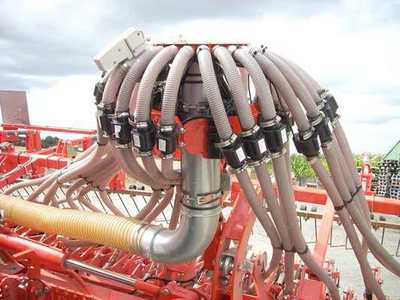
The Isobus Vigilense seed monitor from Dickey-John is mounted on every seeding row. It alerts the user to blocked hoses, disconnected hoses and tramline problems.
The Vigilense seed monitor is the first seed monitor to offer Isobus compatibility. It can therefore interface with the tractor's Virtual Terminal.
Eliminating seeding failures
Seeding "failures" can affect one row or all rows.
There are many causes: blockage of one or more hoses (foreign body in the seed, piece of bag, farm-saved seed with impurities, disconnected hose, crushed hose, blockage of the seeding element (coulters, openers) at ground level by thrown soil or a stone or during a poor manoeuvre (notably reversing while some elements are still touching the ground), a fault in the distribution, a blocked drive wheel, a break in the drive chain, a foreign body blocking the metering unit, no more seed in the hopper or poor distribution in the hopper.
Hopper level sensors give an indication that is not very accurate. Moreover, they do not work with small seeds such as rapeseed. A farmer who wants to empty the hopper completely runs the risk of a shortage.
In practice, farmers often discover seeding failures at emergence, and the damage can be significant: lost income, and lost time and money to re-sow the field.
The Dickey-John Vigilense seed monitor highlights the problem very quickly.
Detection of tramline problems
Two types of problems can be linked to row shut-offs: the valve stays open during tramlining (the row is sown when it should not have been) or the valve stays closed after tramlining (the row is not sown when it should have been).
The Vigilense seed monitor can also detect these faults. The user must first enter into the terminal the numbers of the rows assigned to tramlining.
Time savings and peace of mind
According to Dickey-John, the time savings achieved by users can be estimated at 10%. This time saving comes from the reduced time spent on visual checks. Users have to carry out visual checks very regularly to detect possible faults.
To do so, they must get down from the tractor and check the hoses and the seeding elements: accessibility and visibility are generally not ideal. They also have to check the hopper level several times when they want to empty it (change of variety or of customer for agricultural contractors, etc.).
Some situations carry more risk and therefore require more checking, such as sowing in wet conditions with simplified tillage, sowing field beans, the end of a hopper of rapeseed and sowing with farm-saved seed
The components of the monitors
Vigilense seed monitors consist of 4 elements or groups of elements: sensors, a module (software), harnesses connecting the various elements, and a user interface.
The sensors are generally positioned on every tube of the drill but sometimes on only some of the tubes (1 row out of 2, sometimes only one row, etc.) depending on the user's objectives.
The photoelectric components (emitters and receivers) are positioned face to face on either side of the sensor tube. The inside of the tube is perfectly smooth and presents no obstacle to the passage of seeds.
To suit every situation, the Vigilense sensor is available in 4 versions:
- Vigilense sensor without stainless steel insert for use with seeds. Three tube diameters available: 25 mm, 32 and 45 mm
- Vigilense sensor with stainless steel insert for use with fertilisers. Three tube diameters available: 25 mm, 32 and 45 mm
The module is connected to each sensor by a cable and to the terminal by a wiring harness. It houses the electronic board and its software. It receives information from the sensors and analyses it.
The user interface displays each row. In the event of a problem, an audible and visual alarm informs the user of the problem and indicates which row is "faulty". The user sets the desired alarm threshold on the unit.
The sensors detect seeds when they cut the photoelectric signal (emitters / receivers) inside the tube.
The sensors do not need to be positioned near the ground: they are generally positioned at the distribution head near or inside the hopper. They are thus protected from mechanical shocks and dust.
Even if the blockage occurs several metres from the sensor (at the seeding element), detection will not be impaired, even in the case of a partial blockage.
Indeed, in the case of a partial blockage (e.g. a hose partially obstructed by a piece of bag), the air will be slowed in the tube and the quantity of seed passing through will decrease. This decrease will be detected.