


Editorial team · Tractors
 InfoWeb Marketplace · Editorial team
Published on 13 July 2013 · 2 min read
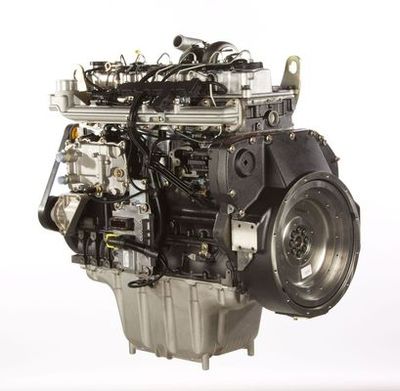
JCB Dieselmax 672: JCB's 6-cylinder, 7,2-litre engine
InfoWeb Marketplace · Editorial teamPublished on 13 July 2013 · 2 min read
Eight years after the first JCB 4-cylinder engine, British manufacturer JCB today announces the start of production of its six-cylinder engine, named "JCB Dieselmax 672".
This 7,2-litre engine delivers 188 ch, 221 ch, 255 ch and 302 ch. It is built on a dedicated line at the ultra-modern plant in Derbyshire, UK, called "JCB Power Systems". In development for more than two years, this engine has already undergone more than 50 000 hours of testing, including 30 000 on machines on site.
It is worth noting that in only eight years, JCB has become one of the world's leading engine manufacturers. This is a remarkable achievement given the increasingly draconian requirements of anti-pollution standards imposed worldwide.
The first engine came off its production line in the UK in November 2004. Since 2011, JCB has also been building engines at its JCB site in Ballabgarh, India. More than 250 000 engines have now been built worldwide.
The introduction of the new JCB 6-cylinder engine represents an investment of approximately £45 million, and its production will be finalised by the end of this year. Its launch has also created more than 50 new jobs.
According to JCB Chairman Sir Anthony Bamford, JCB has "become, over a relatively short period, one of the leading engine manufacturers, and more than 70% of JCB machines are now powered by engines that we produce. The production of the new 6-cylinder engine marks a turning point for our company, a logical continuation of our activities and of our desire to set new standards in performance and fuel efficiency."
The JCB Dieselmax 672 engine is based on the well-established 4,8-litre four-cylinder Dieselmax engine, with parts common to both engines. Built for more than eight years already and after more than 20 000 hours of use worldwide, the Dieselmax engine features electronic control, Delphi common rail fuel injection and a variable geometry turbocharger.
The service interval for Dieselmax engines is 500 hours. The engines will also be offered in the company's OEM product range for use on machines of brands other than JCB.
In terms of performance, JCB announces that the 6-cylinder engine delivers a maximum torque of 1200 Nm. In the tests carried out, the 7,2-litre engine recorded fuel consumption of 189 g/kWh.
In 2006, two four-cylinder Dieselmax engines fitted to a land vehicle achieved the land speed record of 563,27 km/h on the Bonneville salt flats in the United States. The engineering expertise behind this success was drawn upon to develop the latest addition to this engine range.
Advertisement