


JCB telescopic handlers: 40ans of production!
 InfoWeb Marketplace · Editorial team
Published on 2 November 2017 · 3 min read
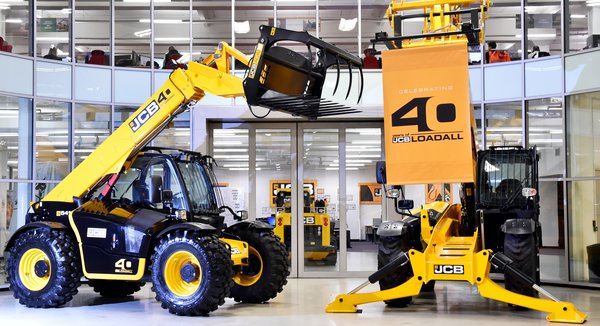
JCB is celebrating an important milestone in its history: the 40ème anniversary of the TELESCOPIC.
First launched on 20 October 1977, the machine mechanised lifting and loading tasks on construction sites, tasks that were generally carried out by hand.
The potential of the TELESCOPIC in agriculture was also quickly exploited. It revolutionised handling tasks on farms, stacking bales, loading manure and grain, replacing the rudimentary hydraulic loaders mounted on tractors.
Daily production of JCB telescopic handlers at the global headquarters in Staffordshire is currently at its highest level since launch. The number of machines produced is expected to increase by 25% by the end of the year compared with 2016. To date, JCB has sold more than 220 000 TELESCOPIC machines, representing £7 billion in turnover, of which £4.5 billion from exports.
The success is such that a TELESCOPIC comes off the JCB production line at Rocester every six minutes. Today more than 1 200 people are employed on the production line.
Today, JCB Chairman Lord Bamford said: ?When we launched the TELESCOPIC in 1977, we sold only 64 machines that year, but we were convinced that the telescopic handler would grow in popularity simply because it made work on construction sites easier. The concept quickly took off and the confidence we placed in the telescopic handler four decades ago has been amply proven...
It is wonderful to celebrate 40 years of JCB TELESCOPIC success with production reaching record levels. I would like to congratulate everyone around the world who has contributed to this success over the past 40 years. We must now look ahead to the next 40 years and build on what has been achieved so far.?
Eddie Finney, 59, team leader in the TELESCOPIC Division at Rocester, says: ?I started my career at JCB in 1976 in the machine shop, but the following year I started working on the TELESCOPIC assembly line.
At that time, only 4 machines came off the line every day. I can't believe the volume we have reached 40 years later.?
Kevin Holley, 60, who works on a laser machine in the TELESCOPIC fabrication shop, said: ?I joined JCB in 1978, working as a flame cutter on several types of machines. I then became a flame cutter for the TELESCOPIC division.
At that time, with only four days of activity per week, the TELESCOPIC production line had a poor image compared with the Backhoe Loader production line, which was busy full time. Even then I could sense the potential. We have grown well and no one else has had similar success.?
Keith Weston, 61, from Marston Montgomery, near Rocester, has worked at JCB since 1973. He says: ?I spent most of my career in general maintenance. I was responsible for shot blasting and painting on the TELESCOPIC assembly line in the 1980s.
In the early days, I hadn't realised that the TELESCOPIC would reach the sales volume it has today. I was proud to work on it.?
It took nearly 30 years for JCB to sell the first 100 000 TELESCOPIC machines, but it took less than 10 years for the next 100 000, which demonstrates the growing importance of the product and JCB's strength in this sector.
JCB is the world number one in telescopic handlers and today more than one machine in three is a JCB.
The public launch of the JCB TELESCOPIC on 20 October 1977 was made with the slogan ?Obsolescence Day is Coming? to indicate that the new machine, with its forward reach and height capacity, would make the conventional forklift truck obsolete.
JCB TELESCOPIC production is fascinating:
- There are 34 basic models and more than 1 000 configurations.
- 14,5 million metres of welding wire are used per year.
- Around 35 steps are required for manufacturing, along with 8 hours of assembly.
- The TELESCOPIC plant consumes more than 35 000 tonnes of steel per year.
- A recent investment of £1 million has funded new precision laser and plasma cutting equipment.
- A 650-tonne steel press forms the boom beam sections.
- On average, it takes 45 minutes to make both sides of the robust chassis.
- 70% of chassis welds are carried out by robots, but skilled operators tackle the hard-to-reach welds.
- Preparation and painting of the booms, chassis and stabilisers (on construction models) take two hours.
- The paint shop uses 73 000 litres of primer and 50 000 litres of gloss paint per year.
- Each TELESCOPIC spends 13 minutes at full speed in a rolling-road test booth to calibrate the driveline.
- Each TELESCOPIC must hold a test weight with the boom fully raised and extended for 10 minutes.