


Editorial team · Agricultural equipment
 InfoWeb Marketplace · Editorial team
Published on 30 October 2007 · 1 min read
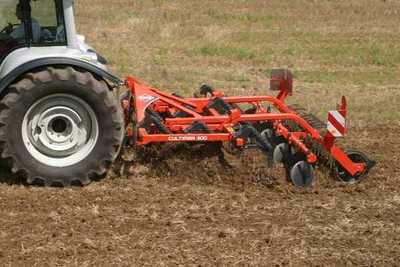
Kuhn's Cultimer Tine Cultivators
InfoWeb Marketplace · Editorial teamPublished on 30 October 2007 · 1 min read
Kuhn is expanding its range of tine tools with the Cultimer. This tool features tines (3 rows on the mounted models and 4 rows on the trailed models) that are said to loosen and crumble the soil, mix it intensively and level the surface in a single pass. The Cultimer range consists of mounted models with working widths from 3 to 5 m and trailed models of 6,5 m and 8 m.
According to Kuhn, the curved shape of the tine promotes the mixing of soil and residues. The large deflector is said to increase the soil-turning effect and to help move residues away.
Fitted with wings, the tine would also allow shallow stubble cultivation after harvest, with the entire soil surface being worked. Without wings, the 80 mm point would allow working depths of 30 cm to restructure the lower soil horizons and prepare the soil before sowing in no-plough systems.
Tine protection is provided by a heavy-section double spring, which is said to prevent any unwanted tine bounce. The large underframe clearance (84 cm) would allow work to be carried out in the presence of abundant crop residues. The tine spacing within the row (90 cm) would reduce any risk of clogging.
The levelling discs, which are attached to the roller support, require no particular adjustment when the working depth is changed. They help leave a flat surface after the tines have passed. The roller controls the working depth of the tines and provides soil reconsolidation. The working depth is adjusted using pins. Depending on the conditions of use and the reconsolidation desired, two types of rollers are available: Tube (Ø 550 mm) or T-Ring (Ø 600 mm), which is notable for its aggressiveness and its action on straw, which promotes its decomposition.
Advertisement