


New Holland received a gold medal and a citation in the Sitevi 2013 innovation awards
 InfoWeb Marketplace · Editorial team
Published on 20 September 2013 · 3 min read
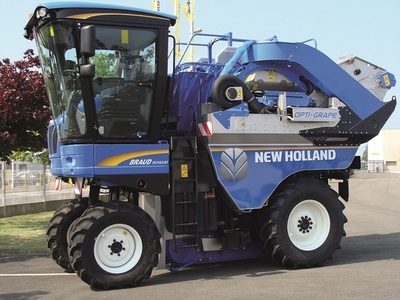
New Holland scores a double at Sitevi 2013 with a gold medal and a citation. The gold medal was awarded to "Opti-Grape", a grape-cleanliness technology.
The citation went to the BusCan system, which delivers real-time ripeness data from the "FORCE-A" sensor on the IntelliView III monitor of Braud 9000 grape harvesters.
"Opti-Grape" technology delivers up to five times better cleanliness and has an impact on shot (millerandage) or botrytis-affected berries
"Opti-Grape" technology, gold medal in the innovation awards, is based on a turbine that injects a pulsed airflow, spread evenly through a micro-perforated grid, to remove all debris other than round berries before it falls into the hopper.
The air cushion is positioned at the end of the cleaning circuit and above the hopper.
Its intensity is set by the operator from the cab on the "IntelliView III" monitor, which controls the turbine speed according to the desired sorting quality. By adjusting the turbine speed, the operator directly manages the cleanliness level of the harvest.
The air cushion is generated through a micro-perforated grid (4300 perforations of 2 mm) in order to remove the tiniest impurities such as petioles, stems, small pieces of wood and leaves, as well as shot or botrytis-affected berries.
Thanks to their wind resistance, all these impurities are lifted above the grapes and removed. The result is a near-perfect harvest quality and therefore an undeniable impact on the quality of the wine produced.
The pulsed air cushion technology was developed to complement a series of improvements to the cleaning system, including the new pre-sorter. This is a system placed directly at the point where the product drops from the conveyor, and it improves cleaning efficiency by up to 20%.
Berries and debris (petioles, leaf pieces, etc.) pass through the gaps between the pre-sorter rollers. Grape quality has been substantially improved because only the bunches pass through the destemmer, thus avoiding any unnecessary crushing of the harvest.
In addition, the upper extractor fan above the receiving belt has also been modified to allow more debris to be removed during the initial cleaning.
The "Opti-Grape" system reduces the percentage of debris in the hopper
The "Opti-Grape" system has undergone very rigorous full-scale tests in both the northern and southern hemispheres. Compared with traditional destemming equipment, the "Opti-Grape" system remarkably reduces debris levels.
On average, between 3 and 5 times less debris remains in the hopper relative to the weight of the harvest, with a debris percentage below 0,1%. Winegrowers will find an obvious advantage here, as the Opti-grape system replaces conventional sorting systems at the winery.
The system does not affect harvesting throughput and can be used at usual working speeds in most red grape varieties. The system can be fully disengaged from the cab if the user does not wish to destem the harvest, for example in white grape varieties.
By removing debris as well as shot or botrytis-affected berries, the system makes it possible to refine the winemaking process, with a direct impact on the quality of the final product.
Anthocyanin quantification: real-time management of grape ripeness
New Holland has developed compatibility between the BusCan system of the Braud 9000 and the "Multiplex" sensor from FORCE-A, so that anthocyanin measurements can be displayed in real time on the IntelliView III color touchscreen.
This Multiplex sensor, available across the entire Braud range 9000, is installed above the hopper.
It uses optical technology to determine the anthocyanin content of the grapes, which is a key indicator of grape ripeness. This instant, non-invasive method does not affect the integrity of the product.
Operators can view and record anthocyanin levels expressed in milligrams per liter. They can also monitor heterogeneity in the hopper on the IntelliView III monitor, thanks to BusCan technology.
The anthocyanin content is displayed with each load going to the winery, which is valuable information for the winemaking process. The system can also connect to the integrated mapping functions of the Braud 9000.
Used with GPS georeferencing data, it makes it possible to create a spatial variability map of anthocyanin content across the entire plot, to help winegrowers adjust inputs in order to ensure optimal grape ripeness.
They can also select a specific plot to obtain a precise blend. This data can be fully integrated with that provided by the EnoControl system, to refine the harvesting process even further.