


Editorial team · Tractors
 InfoWeb Marketplace · Editorial team
Published on 17 February 2012 · 3 min read
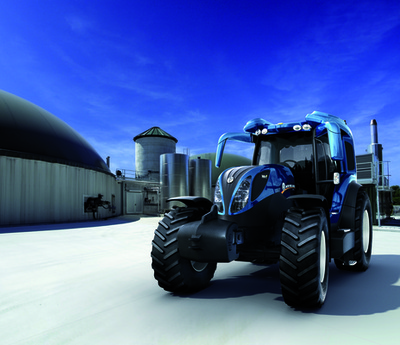
New Holland unveils the new generation NH2™ hydrogen tractor, ready for commissioning
InfoWeb Marketplace · Editorial teamPublished on 17 February 2012 · 3 min read
• Doubled power and torque, extended range
• New functions, optimal performance, zero emissions
• Commissioning at the first energy-independent farm at La Bellotta, Italy, in summer 2012
New Holland Agriculture confirms its role as a Clean Energy Leader by announcing the launch of the new NH2™ hydrogen tractor, which made its world premiere at the Agritechnica show in Hanover (13 - 19 November 2011).
?The new NH2™ is derived from the concept that won the Gold Medal for Innovation at SIMA 2009. It was developed in collaboration with Centro Ricerche Fiat,? said Riccardo Morselli, Head of Innovation Product Development, ?a process that has evolved in order to equip the new tractor with all the functions required to deliver performance comparable to a diesel tractor, both in the field and on the road.?
Doubled power and torque, extended range
Based on the New Holland T6.140 model, this new tractor will be able to run a wide variety of implements for soil preparation, seeding, mowing and baling, and will also handle transport work and front loader applications.
Compared with the first NH2™, the new model has fuel cells that double the power, rising from 50 to 100 kW. The number of fuel cell units has increased from 256 to 384.
The number of on-board electric motors is unchanged, one for traction and the other for driving the power take-off and auxiliary circuits, but their rated power and torque have doubled.
Each of the new electric motors delivers a power of 100 kW, with a continuous torque of 950 Nm and a maximum torque of 1200 Nm. The maximum motor speed reaches 3000 tr/min and efficiency at maximum power is close to 96%!
Of course, to ensure continuous operation of the growing number of fuel cells and keep the tractor in service longer (up to three hours, depending on the load), a larger hydrogen tank has been installed. It can hold a considerable 8,2 kg of hydrogen at a pressure of 350 bar, compared with 2,4 kg on the previous model.
New functions, optimal performance, zero emissions
Other components include a 12 kW, 300 V battery with a peak power of 50 kW, the new continuously variable transmission that replaces the traditional manual gearbox, a suspended front axle and provision for a front loader.
The performance levels of the new NH2™ are every bit as good as those of a similarly sized tractor with a conventional engine. However, it offers a huge advantage: zero harmful exhaust emissions, only heat and water vapor.
With a top speed of 50 km/h, a drawbar power comparable to that of a 120 ch diesel tractor and a hydraulic system delivering a maximum of 113 l/min (the same flow as on the T6.140 model), the new NH2™ hydrogen tractor is a genuine, ready-to-work agricultural machine with all the necessary equipment.
Commissioning at the first energy-independent farm at La Bellotta, Italy, in summer 2012
Commissioning of the NH2™ is planned for summer 2012 at La Bellotta, near Turin, the first energy-independent farm designed by New Holland. The concept is based on the ability of farms to produce electricity from natural sources with a low environmental impact and to store it in the form of hydrogen for later use.
This project, launched by New Holland and carried out in collaboration with a consortium of 13 partners, including API-COM, CNR, CRF, Elasis, ENEA, Envi-Park, Ferrari Costruzioni Meccaniche, Roter Italia, Sapio Verderone, Tonutti and Zefiro, is partly funded by the Italian Ministry of Economic Development.
Three methods of actually producing hydrogen are being studied.
The first is water electrolysis, splitting water into oxygen and hydrogen, using electricity produced by a photovoltaic system already installed on the farm.
The second method is small-scale steam reforming of natural gas; if this method proves practically applicable and economically viable, it would be possible to use methane produced by the digesters of the MegaWatt biogas generators, which have been in operation at La Bellotta for over a year.
The third hydrogen production method, the most innovative of all, consists of exploiting the anaerobic fermentation of biomass: a biological process that generates a gas mixture containing a significant proportion of hydrogen. This method will also be assessed in terms of feasibility, costs and benefits.
A hydrogen tank will be installed on site, connected to a compressor, allowing the NH2™ to refuel like any other tractor.
Advertisement