


Sulky-Burel unveils its Progress pneumatic seed drill
 InfoWeb Marketplace · Editorial team
Published on 21 February 2020 · 4 min read
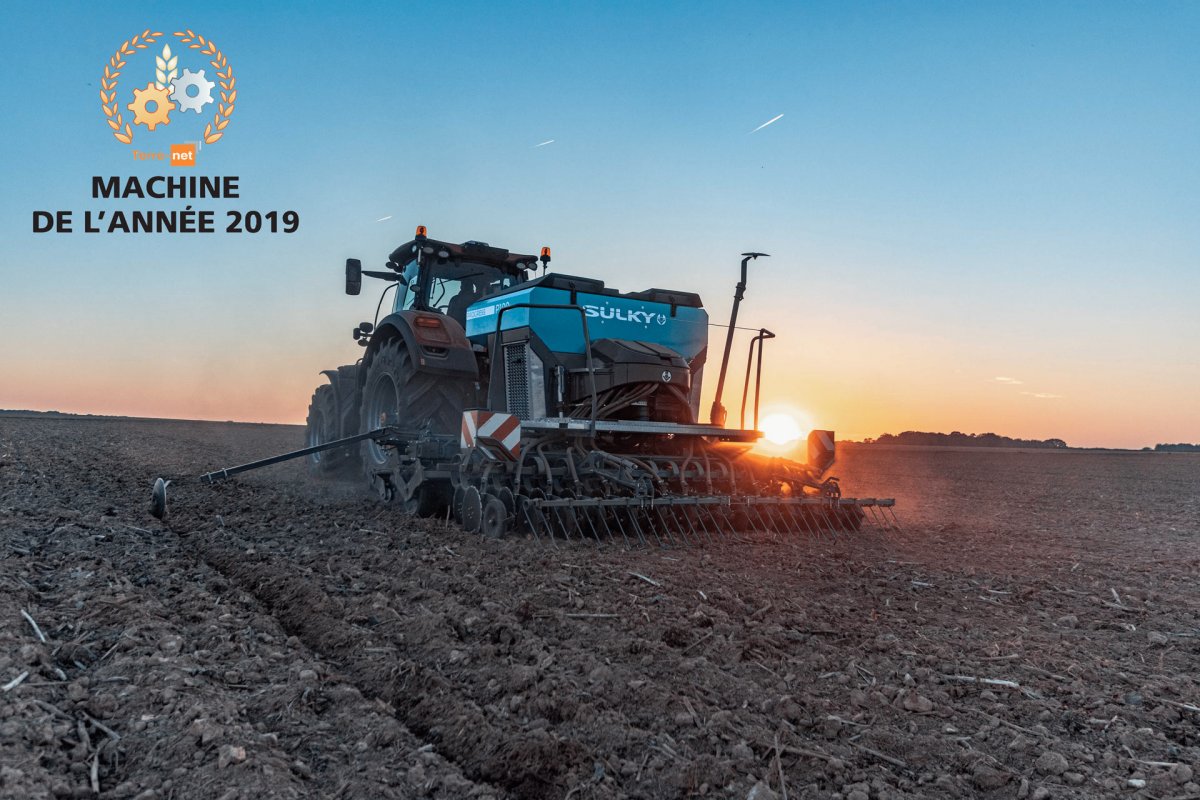
The new pneumatic seed drill offers the unprecedented ability to place three products simultaneously on a rear-mounted seed drill 3 m or 4 m wide. This design makes the Progress the flagship of new agroecological practices, now accessible to as many farmers as possible, thanks to the removal of constraints in terms of power, size and investment.
What is the plural of "progrès"? "Progress"! the engineers in Sulky's design office would be tempted to answer, if they were not as sharp in spelling as they are passionate about mechanical and electronic engineering.
When it came to seeding, as they began to define the outlines of the Progress, their specifications were as follows: how to capitalize on the achievements of a seeding combination widely proven in the 20th century, while meeting the agroecological challenges of the 21st century, which can be summed up in two words: produce better. In other words, the aim is to reduce the impacts of agricultural practices (biodiversity, compaction, contamination, greenhouse gas emissions, etc.) while demonstrating sobriety in terms of energy, plant protection products, water and mineral nutrition, and if possible offering, as a bonus, a safeguard against climatic hazards.
At the origins of the Progress pneumatic seed drill
The challenges are tough, but for a few years now, agronomy has drawn on its resources and has begun to put forward practical solutions. In fertilization, for example, improving efficiency depends on localizing inputs, whether starter fertilizers to promote crop establishment (a crop that will better resist pests and climatic hazards), phosphorus, whose availability and low mobility are limiting factors for yields, or nitrogen (provided that legislation allows it). Localization is also of interest for plant protection products, such as slug pellets.
Companion cropping is also very promising for agroecology. The most emblematic combination is oilseed rape and faba bean, the latter contributing to the fertilization of the rape (between 30 and 40 kg/ha), to reduced weed competition (up to 40% compared with oilseed rape alone) and to the regulation of insects such as flea beetles (through a masking effect), all credited with a yield gain of around 3 q/ha. Other combinations based on phacelia, dwarf white clover or lentil are conceivable. In organic farming, multi-species associations are widely favored to maximize self-fertility. Another source of progress lies in varietal associations within a single species. In wheat, for example, they can deliver higher yields and/or maximize quality (protein content), or even reduce susceptibility to disease. Let us not forget cover crop mixtures in the intercropping period, with benefits almost as numerous as the species involved: soil structuring through root colonization, preservation of biological life, prevention of the risks of excess water (waterlogging) and erosion (wind and water), reduced risk of leaching of fertilizing elements, limited evapotranspiration, maximized available water capacity, carbon sequestration, enrichment of the soil with organic matter, contribution to fertilization, preservation of biodiversity, etc.
From observation to the practical implementation of the Sulky-Burel pneumatic seed drill
How can you apply up to three inputs in a single pass, strictly respecting the recommended rates and/or densities, with optimized placement of the inputs in the soil, so as not to risk undermining the benefits mentioned above? In theory, by splitting the seed drill hopper into three compartments. More practically, the trade-off follows the most representative observations in terms of size (of seeds and granules) and of densities and/or rates. The Progress actually offers the following volumetric distribution: 1200 liters for hopper 1 and its versatile fertilizer/seed metering unit (0,5 kg/ha to 450 kg/ha), 800 liters for hopper 2 and its versatile fertilizer/seed metering unit (0,5 kg/ha to 450 kg/ha) and finally 100 liters for hopper 3, fitted with a metering unit able to distribute seeds, fertilizers or micro-granules within a range of 0,6 kg/ha to 15 kg/ha. Of course, he who can do more can do less. The two largest hoppers can be reserved for a single species, a single variety.
With the Progress, there is no more risk of unmixing or makeshift installations of additional hoppers on single-hopper machines. It goes without saying that the ergonomics of the settings have been carefully worked out. Flow rate tests are carried out simply and safely from the platform, where all the controls are centralized on a single control panel. A water reserve built into the housing of the distribution head, with a tap located at the rear of the machine (cleanliness point), allows the user to wash and decontaminate their hands before getting back into the cab. A storage space for PPE (goggles, gloves, mask) is also provided at this cleanliness point. With these attributes and its three hoppers, the Progress would perhaps not have been unworthy... three "s".
The new Progress seed drill range
Available in 3 m, 3,5 m and 4 m, the Progress can be configured with one, two or three hoppers. Fitted as standard with Isobus technology, the Progress can automatically optimize, by GPS, the stopping and starting of the metering units at the headlands, avoiding overlaps and surface seed deposits. It also automatically runs seeding rate modulation maps by GPS. The Wiso interface, specially developed for the Progress, makes it possible to control the 3 metering units from a single interface. Wiso can be displayed on an Isobus console or on an iPad tablet in the cab with remote control of certain functions via Wi-Fi. The Progress can also manage automatic modulation maps by GPS. The Progress P20 is fitted with the Unisoc seeding line with 3 rows (20 kg), the Progress P50 with the Twindisc double disc (smooth discs offset by 320 mm, 50 kg) and the Progress P100 with the Cultidisc (notched disc of 410 mm, 100 kg). The Progress P20, P50 and P100 are combined with HR rotary harrows (4 rotors per meter). The Progress P100 can also be combined with the XR disc tool (notched discs of 415 mm).