


The 7950i, John Deere's high-power forage harvester
 InfoWeb Marketplace · Editorial team
Published on 4 September 2009 · 4 min read
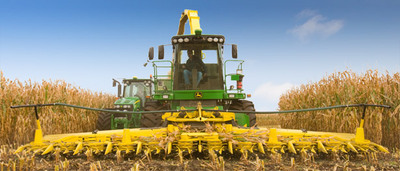
The John Deere 7950i is a 812 ch self-propelled forage harvester.
This very high-capacity machine, designed in particular for contractors, can harvest up to 300 tonnes of maize per hour, thus filling a 40 m3 trailer in less than 2,5 minutes.
Various design changes have been made to the John Deere 7950: a chassis 150 mm longer, a 4 wheel drive rear axle (for ProDrive) with a 160 cc hydrostatic motor (instead of 140) and a reinforced differential, reinforced final drives of 335 mm, and a lifting capacity increased by 23% (70 mm cylinders).
All the components that transmit the engine's new power to the chopping unit have also been resized.
The continuously variable cut length gearbox has also been reinforced: 45 cc hydrostatic motor (previously 37 cc), a new hydraulic accumulator for more powerful reversing (notably with a 12-row header), and a clutch resized to 2000 Nm (vs. 1700 Nm).
The 240 mm diameter kernel processor is driven by a 4-rib belt.
Control of operating costs was built into the development of the 7950, with the option to order wear parts with the DURALINE surface treatment.
This treatment significantly increases the resistance of the parts in contact with the crop: rotor floors, rotor/processor/accelerator transitions, accelerator floors, the first wear parts of the spout, and the spout cap.
The efficiency of the driveline of the new John Deere 7950i self-propelled forage harvester would reduce fuel consumption to only 0,5 litres per tonne of maize harvested. The combination of the multi-knife rotor and IVLOC delivers the best silage quality on the market.
Automatic engine speed and ground speed management system
As exclusive features, 3 'intelligent' modes on the John Deere 7950i self-propelled forage harvester allow customers to maximise their performance on the road and in the field:
- The new ?Road Mode? engages at an engine speed between 1250 and 2100 tr/min and provides additional torque when needed during transport (climbing, difficult terrain).
When this additional torque is no longer required, the engine speed drops to the minimum level (1250 tr/min) while maintaining the desired speed. This system reduces fuel consumption by up to 8%, provides 27% additional torque to climb the steepest slopes and shortens transport time.
- The ?economy headland? mode saves fuel on headlands.
When stopping or manoeuvring at the end of the field, this system automatically reduces the engine speed (down to 1250 tr/min) and then raises it again when the manoeuvre is complete and the machine enters a new windrow or a new row.
This results in up to 5% additional fuel savings.
- In addition to the ?economy headland? mode, the ?economy performance? mode combines automatic ground speed management with engine load, which keeps the engine speed within the economical consumption range (1850 tr/min).
This ?economy performance? mode alone delivers a 5% saving on the fuel bill.
Intelligence at work with the John Deere 7950i
The exclusive John Deere AutoLOC system selects the ideal cut length according to the dry matter content. AutoLOC combines the IVLOC cut length gearbox with the HarvestLab dry matter sensor.
The latter, mounted on the spout, measures the dry matter of the silage using Near Infrared technology.
Complementing this system, the exclusive HarvestDoc documentation software provides traceability of the forage harvest. This software documents all the information available on the forage harvester and records it with geo-referencing.
New headers allowing year-round use of the self-propelled forage harvester
To maximise their return on investment throughout the year, customers with self-propelled forage harvesters can choose between 4 different headers to increase the versatility of their machine.
- The new 600C series windrow pick-ups perform better in heavy crops. Their structural improvements allow them to be fitted to high-power John Deere forage harvesters.
Notable features that significantly increase performance are: the windrow roller press with automatic lifting during reversing, the pivoting gauge wheels, the auger floor scrapers, the reinforced bearings of the tine bars, the new feed auger protection and the pivoting frame.
- To feed biogas production units, John Deere self-propelled forage harvesters can now be fitted with the new Zürn Quickcut headers, a simple and efficient solution that delivers a precise cut and short stubble.
This header works with a high-capacity rotary disc cutterbar and saves up to 26% of fuel per tonne of crop. The Quickcut is driven directly from the IVLOC cut length transmission and is fitted with an integrated protective clutch.
- To make full use of the capacity of the 7950 and 7750 forage harvesters, John Deere has developed the new 12-row Champion 390 Plus header. It is a rotary row-independent header with a working width of 9 metres, capable of harvesting maize as well as immature cereals.
The 390 Plus offers excellent manoeuvrability in small plots and reduces soil compaction by limiting passes.
The crop flow has been optimised, in particular during transfer to the forage harvester's feed rollers, allowing larger crop volumes to be absorbed.
To improve the harvesting of lodged crops, the outer dividers have been redesigned. Foldable, with a maximum transport width of 3,3 metres, the 390 Plus header is equipped with an independent transport wheel that reduces the ballast needed at the rear of the forage harvester and provides better visibility on the road.
- To extend the use of the forage harvester into winter, John Deere self-propelled forage harvesters can now be fitted with the new CRL header to harvest short-rotation coppice and feed biogas production units.
This header is supplied with its own drive system, including an additional oil pump, a cooler and an oil tank, as well as protective shielding.
A large front deflector protects the cab at all times when harvesting willow or small trees with a maximum diameter of 10 cm. The fast-rotating cutting unit ensures a steady flow of material to the forage harvester's chopping unit.