


Three new Case IH Axial-Flow combine harvesters in the 250 series
 InfoWeb Marketplace · Editorial team
Published on 7 December 2018 · 7 min read
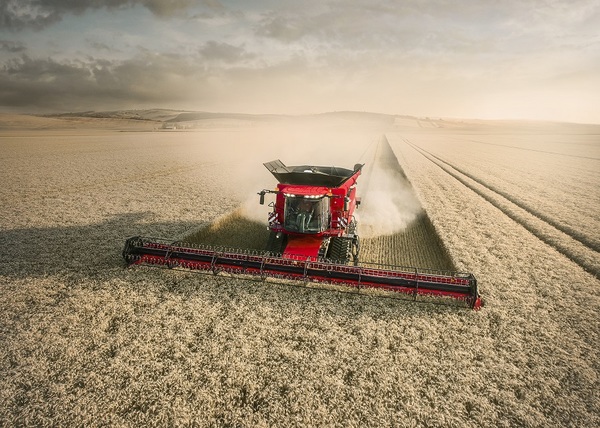
Case IH will market three new Axial-Flow combine harvesters in the 250 series in 2019, replacing the current 7240, 8240 and 9240 models.
They stand out for several automated functions designed to let users easily optimize the machine's performance in terms of throughput and harvest quality.
New AFS Harvest Command™ automation system
The improvements made to the new Axial-Flow 7250, 8250 and 9250 combine harvesters concern Case IH's AFS Harvest Command™ automation system.
This brand-new technology uses sixteen sensors to monitor the combine continuously and adjusts seven different parameters to maximize its performance.
Managed from the AFS Pro 700 terminal in the cab, this automation system is suited to wheat, rapeseed, maize and soybean harvests. The user only needs to make a few settings according to the crop type and conditions for the machine to reach the desired output.
The basic version of AFS Harvest Command™ is equipped with the widely proven ACS (Automatic Crop Settings) system. It adjusts the various components, such as fan speed and concave clearance, according to the crop type selected on the AFS terminal screen, which removes the need to adjust each element individually. The user can fine-tune the combine settings as work progresses and save the settings for later reuse.
The next version, equipped with the Feedrate Control system, adjusts the forward speed according to the crop load in the feeder to achieve the desired results or performance, in order to limit losses and reach maximum or fixed throughput.
The user only needs to set the maximum engine load and the forward speed for Feedrate Control to operate up to the set limits.
The new Feedrate Control system allows more precise adjustment of forward speed according to the crop and the traction load. It can be used on its own and is suited to all crop types.
The top-of-the-range option is the fully integrated AFS Harvest Command™ automation, which automatically adjusts the threshing and cleaning system according to the same criteria as Feedrate Control, with the addition of grain quality monitoring.
This new technology relies on cameras and sieve pressure sensors to provide additional input to the machine's automatic adjustment process, in order to limit impurities in the grain sample and thus preserve its optimal quality, the characteristic on which the reputation of the Axial-Flow combine is built.
?The AFS Harvest Command™ automation system camera uses a patented multispectral light source, visible and invisible, to identify broken grains and impurities more accurately,? says August von Eckardstein.
?This patented technology helps the camera monitor the quality of the grain sample more precisely by illuminating it with UV, blue, green, red and infrared light.
By combining these five light spectra, the system optimizes the detection of visible starch in broken grains. The AFS terminal alerts the user if dirt is obstructing the camera's view.?
The fully automated AFS Harvest Command™ can be used in four different ways. In every case, the user sets a maximum engine load and a maximum forward speed so that the combine operates in:
Performance mode: the combine travels at a certain speed to reach an acceptable level of grain loss from the rotor and the cleaning system.
Fixed throughput mode: the combine maintains a target throughput by changing its speed and adjusts itself to limit losses.
Maximum throughput mode: the combine operates until it reaches the speed or power limit set by the user, while adjusting its settings to limit grain loss from the rotor and the cleaning system.
Grain quality mode: the combine adjusts its settings to maintain the targeted grain quality and impurity level, while limiting losses.
After selecting the ?Basic? tab on the AFS screen, the user must enter the crop type, the desired strategy, the maximum forward speed and the maximum engine load. The system then engages and harvesting begins. Fine-tuning is possible via the ?Advanced? tab, which makes it possible, for example, to change the initial start-up or the frequency of automatic changes and to adjust threshing ease.
?The AFS Harvest Command™ automation system was not designed to replace the user and make decisions in their place, but rather to optimize them, by identifying the factors that limit the combine's performance when conditions change, displaying them and making the adjustments to deal with them,? says August von Eckardstein.
?Experienced users can further improve their output and the quality of the harvested grain, while beginners are able to reach productivity comparable to that of experienced operators more quickly. In both cases, AFS Harvest Command™ lets them pay less attention to certain factors, such as loss or fan and rotor speed, and focus more on header position and unloading.?
Improvements to the rotor cage and sieve
Axial-Flow 250 series combines with AFS Harvest Command™ are equipped with rotor transport vanes adjustable from the cab, operated from the right-hand console in the cab when the automation system is not in use, or automatically when the AFS Harvest Command™ automation system is engaged.
The six rear vanes are linked and offer a wider adjustment range. They can also be adjusted manually from the ground. Changing the pitch of the vanes speeds up or slows down the passage of the crop through the rotor cage, while adjusting threshing and separation performance to harvest conditions improves output.
In combination with the upper and lower sieve control, the AFS Harvest Command™ automation package is also equipped with a new cab-controlled pre-sieve adjustment device, which allows the AFS Harvest Command™ system to automatically adjust all sieve settings based on input from the loss sensors, the grain quality camera and the sieve pressure sensors. It can also be activated manually when AFS Harvest Command™ is not running.
The sieve pressure sensors send data on sieve load to AFS Harvest Command™, which allows the system to understand the risk of losses and make the necessary adjustments before they occur. These sensors link sieve overload to losses, and adjust the fan and sieve settings accordingly.
This technology thus prevents grain losses when yields vary and at the headland. In combination with the Auto Fan option, the system also takes the combine's inclination into account. Fan operation in combination with the sieves maintains the ideal operating setting and the optimal sieve pressure.
Transmission changes
A new continuously variable transmission, equipped with Field and Road mode control and real-time two-speed range control, improves traction and removes the need to stop and change mode during work or when traveling on sloping terrain.
Controlled by a modular multifunction speed controller, it provides closed-loop speed control to maintain the set speed when ground conditions change.
The respective maximum speeds in range one and two are 18 km/h and 25 km/h, although the maximum values can be set according to user preferences and ground conditions.
?As there are fewer range changes and the maximum speeds are adjustable, downtime is limited in favor of productivity,? says August von Eckardstein.
Complemented by optimized hydraulic drives, the improved transmission improves smoothness by 36 % when traveling on the road.
At the same time, a new advanced differential lock replaces the previous mechanical pedal with an electric button mounted on the floor, while the external brake disc is replaced by an internal oil-bath-cooled brake, which provides the same braking force with less effort on the pedal while improving the cooling performance required in situations where continuous braking is necessary.
Feeder improvement
In addition to the current feeder lifting capacities of 4,5 tonnes and 5,2 tonnes, a new lifting capacity of 6,1 tonnes is available on the largest Axial-Flow models to make it easier to handle 12,6 m draper headers and 16-row corn headers.
A factory-fitted dual lateral tilt system can now also make it easier to control 12,6 m draper headers.
A new optional cab-controlled fore/aft adjustment function for the feeder face allows the user to change the fore/aft angle of the header, over a total tilt of 11,9 degrees.
This improves harvesting efficiency for short crops (beans) and tall crops. Improvements to the header height control function result in better responsiveness and float, as well as adjustable acceleration for return to cutting position and resumption.
The GRAS (Ground Speed Adaptive Sensitivity) system automatically adjusts header height sensitivity as the forward speed increases or decreases in order to maintain header stability and responsiveness.
For example, when the response sensitivity is set to a high value and the user reduces the combine's forward speed, the system's sensitivity also drops to preserve header stability.
However, as the sensitivity setting remains at the high setpoint, header responsiveness is preserved when the user restores the previous forward speed.
AFS Connect availability
Our factory-fitted AFS Connect telematics system allows two-way file transfer between the combine and the office computer via a web portal.
All combines are pre-wired and fitted with an antenna to receive the required modem. If the customer orders a combine pre-equipped for telematics, a modem is factory-fitted to the model.
The user then simply enters an unlock code to have the full telematics version. The modem is initialized at the factory, while the subscription must be taken out with the dealer.
Find more information here on Case IH Axial-Flow 250 series combine harvesters